jdilla.xyz

House of Broken Angels

2021-12-04

House of Broken Angels Cover

I picked up House of Broken Angels as another stop on my literary tour of California, but after reading it, I wouldn’t call it a California book. It’s a San Diego book, through and through. I’m not sure how it reads to someone who hasn’t lived here, but even as a relatively new resident, I recognized places and neighborhoods.

House of Broken Angels is the story of two half brothers, both named Angel, of a man from Tijuana as the elder Angel (Big Angel) nears death from cancer. The two Angels wrestle (figuratively and literally) with each other’s and their father’s sins, as do the rest of their families. It’s a book about how short life is and about how frail humans are.

The other thing that places this book in San Diego is the connection the characters have to Tijuana, where the main character immigrated from. The two cities, just 20 miles a part, share an economic and social relationship. They mayors regularly meet with each other. Now that I live here, this seems obvious, but it surprised me at first.

The book brings the relationship between the two cities to life. The Angels’ father is from Tijuana, but immigrates to San Diego when he leaves his first wife (Big Angel’s mom) for his second wife (Little Angel’s mom). When I lived in Europe, one of my favorite things were the border regions where cultures bled into each other. The Italian part of Switzerland, which feels like both Italy and Switzerland, the northern part of Spain, the feels both Spanish and French. San Diego has elements of that. This book the way that people, relationships, and culture move back and forth across the border.

To me, the best part about this book was the way that it approached the end of life, the yearning for one more Christmas morning, and regret over mistakes. The other thing I’ll take from it is some understanding of the Mexican-American San Diego experience.

Dr. Maggie Lieu on when humans will make it to Mars, robot maids, and the standard model of cosmology

2021-11-20

The brilliant Dr. Maggie Lieu aka Space Mog was kind enough to join me on Browser Bets. I was surprised to learn that she volunteered to go to Mars and was very nearly selected.

Our bets:

Bet 1: Humans will land on Mars by 2035 James says before, Maggie says later. Maggie thinks it will be China, James hopes it will be the US.

Bet 2: We’ll have generalizable robots in our houses by 2035 Maggie says no way, James says yes out of an unfounded sense of optimism.

Bet 3: The standard model of cosmology will be overturned by 2035 by something that aligns quantum physics and relativity. Maggie says yes, James says no.

My conversation with Sebastian Park

2021-10-31

Sebastian is an e-sports executive, investor, and entrepreneur. We made bets about the future of NFTs, the Creator Economy, and UGC gaming. In between, I learned about how working for Darryl Morey influenced how Sebastian thinks about predictions.

Here are the bets we made:

  • The future of NFTs: No more than 2 of the top 50 NFT projects on OpenSea.io will still be there in October 2023 (Last 30 day trading volume)

  • The future of the Creator Economy: If you look at the top 10 web3 companies in 2023, less than 30% of the value will come platform companies.

  • The future of UGC gaming: By 2030, we will see the same fragmentation in gaming that we do in video. More hours of playtime for top UGC game platform more than the top studio game.

A transcript is available here.

Grapes of Wrath

2021-10-26

The next book in my literary survey of California has been Grapes of Wrath, the iconic novel that I missed in high school.

The book tells the story of the Joan family as they leave Oklahoma and head west to California, driven by the Great Depression, mechanized farming, and poverty.

[I’m not going to review the book since I don’t think that’s useful for a book of this stature. I’m just going to reflect on it. I’m also not going to worry about spoilers, so if that bothers you be warned].

The book is extremely well paced. Steinbeck slowly turns up the pressure, showing how poverty forces the Joads from one no win situation to another. After enough least-bad options, the family eventually breaks apart. The slow creep of ruin really affected me, as did the images of starving children and pregnant women.

I was surprised at how deep I was into the book before I realized how bleak the ending would be. There wouldn’t even be the satisfaction of a shootout.

The ending! I can’t believe no one I knew let on even a little bit about how weird it is. I can’t claim to understand it.

It’s impossible to read this book now and not think of the homelessness crisis in California. I’m sure some of the members of California’s current tent camps would agree with Steinbeck that the police cause more injustice than the people.

For better or worse, the claiming of land is a part of the California psyche. Wether it is water rights, land claims, zoning, or the right to keep your view in a California beach town, there is a preoccupation with protecting one’s claim from others in the golden state.

I think the biggest thing that this book added to my understanding of California is an appreciation for how turbulent the period mass inward migration was, even though it is a crisis that has now passed. I think I understand better why it was such a big deal.

On the whole, I enjoyed the book. Although I liked East of Eden more, I thought the characters in Grapes of Wrath, particularly the female characters were more fully imagined.

One year with Doulingo

2021-10-13

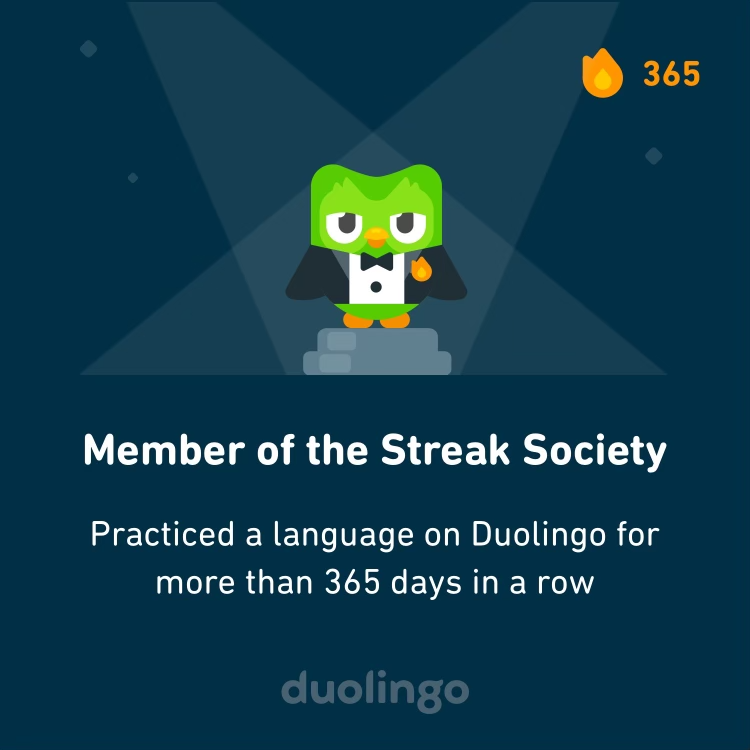
I'm more proud of this than I have any right to be. This morning I made it to 365 straight days of practicing German on Duolingo. Unsurprisingly, after using it for this long, it's become one of my favorite apps (1).

When I first started using Duolingo, it was as a supplement to tutoring sessions with a teacher, but when we moved from Switzerland, I no longer had the bandwidth for classes. Since then, my German practice has been Duolingo, the NZZ podcast Akzent, and reading the occasional children's book to my daughter. I have to admit, I'm surprised at how effective Duolingo is. I can tell from my other German language activities that I'm better today than I was 3 or 6 months ago.

Here's what I love about the app:

  • They've mastered habit building. For me, learning a language is all about reptition and Duolingo is the easiest to use repeatedly. Just like the best camera is the one you have with you, the best language app is the one you use most often. Duoling nails this.
  • They have so many overlapping ways that they incentivize good language learning habits:
    • Streaks, to get you in the app every day
    • Hearts, to incentivize you to not rush through the course
    • Experience points, which incentize depth of knowledge
    • Gems, which pay off if you reach your goal
    • Leagues, which create social pressure / competition
    • Badges, which reward continued investment
    • Crowns, which reward completing lessons
    • "Cracked" lessons, which reward revisitng material. I think this is everything, but I'm probably missing something.
  • The overall playfulness of the app, which comes out in the sounds they use when you're right or wrong, and the characters that they use in their lessons

After 365 days, here's what I wish they'd do differently:

  • I'm never sure if I'm using my time in the best possible way. Learning a language is a tradeoff between picking up new material and going back and practicing mistakes. All the features Duo has makes it tough to know if I'm in the right spot. I wonder if there is a TikTok-esque version that drops you in and just drills you based on where you stand algorithmically.
  • Duo really isn't great at reading comprehension. They have a stories feature that helps with this, but it's sort of off to the side. As a user, I'm left to figure out how to integrate these two experiences (which is basically my previous criticsim).
  • They haven't solved speaking practice. They have cool features that get you to pronnounce words, but there's nothing like live conversation and having to truly think in another language. They have an "events" feature where you can join free or paid groups, but it's super buried.
  • I'm surprised they don't have a platform for language teachers. I would happily sign up for a 30 min or 1 hr weekly practice session with a language teacher, yet I'm left to go off platform to find this person. When I find them, the first session is going to be an assessment, which Duolingo should be well positioned to provide.
  • I can't believe they don't have gear (t-shirts, hoodies) or digital stickers that you can buy that only gets unlocked once you get to a certain level. Seems right up their alley. So here's to another year. I sort of imagine that afer I progress to a certain level, I'll need other resources. But we'll see!

1: I'm obligated at this point to mention that Duolingo is a Pittsburgh company